
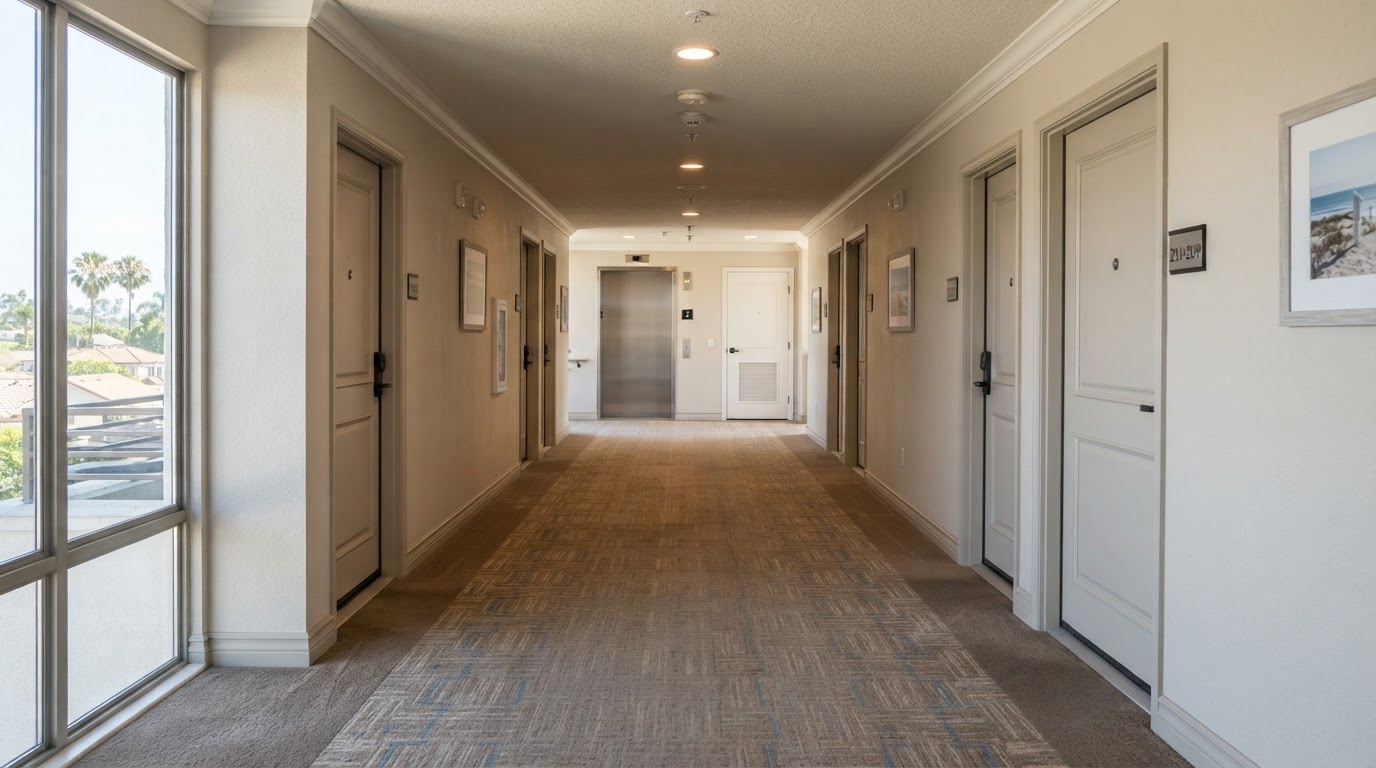
How Often Should Apartment Common-Area Carpets Be Professionally Cleaned in San Diego?
There is no single schedule that fits every apartment community. How often common-area carpets should be professionally cleaned depends on traffic patterns, entrances, building use, visible condition, and the property's goals — not a fixed interval. This article is for San Diego property managers and multifamily operators who want to understand what affects common-area carpet cleaning needs and when it makes sense to contact a professional before the carpet becomes an obvious problem.
Common-area carpet is different from carpet inside one rental unit
Carpet inside a single apartment is walked on by a small number of residents. Common areas — hallways, stairwells, lobbies, elevator entries, and main entryways — are walked on by every resident, guest, delivery person, and vendor who enters the building, often while tracking in sand, moisture, and debris from outside. Over the course of a week, a busy San Diego apartment hallway may see hundreds of passes, many of them with whatever is on people's shoes.
That difference matters because common-area carpet wears and soils differently than unit carpet. A single rental unit might need a turnover cleaning between tenants, while the hallway outside it may quietly accumulate soil for months with no single event that triggers attention. You can read more about the turnover side of things in our article on apartment turnover carpet cleaning in San Diego.
Why common-area carpet can decline gradually
Common-area carpet rarely becomes a problem overnight. It slowly starts to look normal to the people who pass it every day, until a prospective tenant, resident, owner, or visitor notices it immediately. Because the change happens a little at a time, the people who manage the building can stop seeing it — while someone walking in fresh sees it right away.
This is the core challenge with common-area carpet: the slow decline is invisible to the people closest to it. Soil settles into the fibers a bit at a time, traffic lanes darken gradually, and spots that would have been cleaned up immediately in a unit may be walked past in a busy hallway until they blend in. By the time the carpet looks obviously bad, the building has often been showing that condition to new prospects for weeks.
What can affect how often professional cleaning may be needed
Rather than a fixed frequency, the cleaning needs of a common-area carpet depend on a handful of factors that vary from one building to the next:
- Traffic volume. A building with many units and one main entrance routes far more foot traffic through a single hallway than a smaller property with multiple entries.
- Entrance and layout. Properties with an entry mat system and a short run to units may keep more soil out than one where the front door opens directly onto a long hallway or stairwell.
- Building use. Pet-friendly communities, buildings near the coast with higher humidity, and properties with heavy outdoor foot traffic tend to see more soiling and odor concerns.
- Visible condition. Darkening traffic lanes, spots, and lingering odor are signs the carpet is past routine upkeep and may benefit from professional assessment.
- The property's goals. A community preparing for lease-up, an ownership review, or a high season of showings may have different timing needs than one in steady operation.
Because these factors interact, two buildings on the same block can have very different cleaning needs. That is why a professional assessment tends to be more useful than a printed schedule applied to every property the same way.
Signs the carpet may need professional attention
A manager may notice a few things that suggest a common-area carpet is ready for a closer look:
- Visible traffic lanes in hallways or at the base of stairs that stay dark even after routine vacuuming.
- Spots or stains near entries, elevator doors, or stairwells that no longer respond to spot cleaning.
- A lingering musty or stale odor, especially in coastal buildings where humidity can settle into carpet fibers. For a related look at that issue, see our guide on how property managers handle odor in vacant units.
- Fibers that look matted or flattened in high-traffic areas, which can mean soil has worked deep into the pile.
- Feedback — direct or indirect — that prospects or residents are noticing the condition before anything else.
These are signals worth a closer look, not proof that a carpet must be cleaned on a particular date. The practical step is to have the condition assessed so the decision is based on what the carpet actually needs.
What Brothers evaluates before recommending service
When a manager contacts Brothers about a common-area carpet, the starting point is the condition of the space, not a preset program. An assessment typically looks at the visible soiling, traffic patterns, staining, any odor, and how the area is used. From there, Brothers can discuss whether professional carpet cleaning makes sense now or can reasonably wait.
The goal is an honest read on the carpet rather than a one-size- fits-all recommendation. A carpet that still has life and is only lightly soiled may not need immediate service, while one with deep traffic lanes and odor may benefit from prompt attention. That assessment helps a manager spend on the right work at the right time instead of reacting after the condition is already obvious.
Why waiting for a carpet to look "ruined" can limit options
Waiting until a common-area carpet looks ruined tends to create two problems. First, by the time soil is that visible, it has often been visible to prospects for weeks, which can shape their impression of the whole property before they tour a unit. Second, heavy, ground-in soil is harder to address and leaves fewer options — a carpet that could have been restored with cleaning may reach a point where cleaning is less effective or replacement becomes the discussion.
That is why it usually works better to assess the carpet before it reaches that stage. If your community also handles turnovers that depend on fast dry times, our article on fast carpet drying for apartment turnovers covers how timing fits into that process.
FAQ for San Diego property managers
Is there a standard schedule for cleaning apartment common-area carpets?
No single schedule fits every building. Frequency depends on foot traffic, entrances, building use, visible condition, and the property's goals. An assessment of the carpet's condition is the most reliable way to decide when cleaning makes sense for your community.
Do common-area carpets need cleaning more often than unit carpets?
They often need attention on a different cadence because they see far more — and more constant — traffic. Hallways, stairs, and lobbies also collect outdoor debris and pet traffic that a single unit usually does not, which changes how the carpet wears.
Can Brothers tell me whether my common-area carpet needs cleaning now or can wait?
Yes. Brothers assesses the visible condition — traffic patterns, soiling, staining, odor, and fiber wear — along with how the space is used, and then discusses whether cleaning is appropriate now or can reasonably wait. The goal is an honest assessment, not a preset schedule.
Related Reading
Unsure about your common-area carpet?
If you manage a San Diego apartment community and are unsure whether your common-area carpet needs professional attention, contact Brothers Carpet & Restoration to discuss the condition of the space and the right next step.